




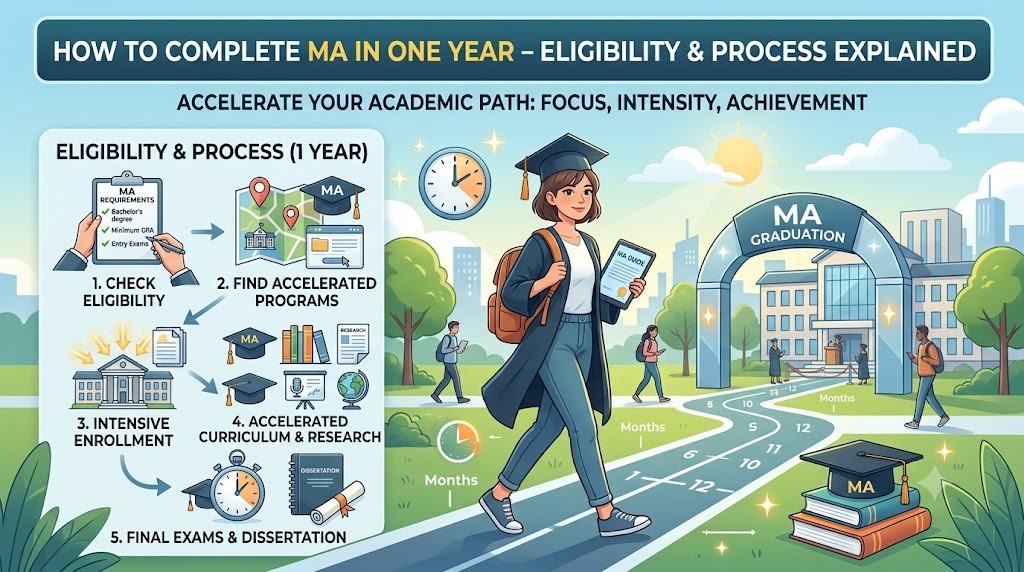
A Master of Arts (MA) degree is a postgraduate program designed to provide advanced knowledge in humanities, social sciences, languages, and related fields. Normally, an MA program takes two years to complete in most universities. However, many students search for options to complete an MA in one year through fast-track or alternative academic pathways.
In reality, a standard MA cannot be compressed into one year for all students. But in some cases, accelerated completion may be possible through specific academic routes such as credit transfer, lateral entry (where applicable), or recognition of prior learning, depending on university regulations and eligibility criteria.
Understanding the MA Program Structure
An MA degree is typically divided into semesters and includes:
- Core subjects in the chosen specialization
- Elective papers
- Research methodology
- Assignments and internal assessments
- Dissertation or project work (in many universities)
The purpose of the program is to develop analytical, research, and subject-specific expertise at an advanced academic level.
Is It Really Possible to Complete MA in One Year?
A full MA degree is generally not designed to be completed in one year. However, some institutions may allow reduced duration in limited cases based on:
- Previous postgraduate coursework
- Credit transfer from a recognized university
- Exemptions for similar subjects already completed
- Recognition of Prior Learning (RPL) in some systems
These options are highly regulated and not available in all universities.
It is important to verify whether the institution is officially recognized before considering any accelerated MA program.
Who May Be Eligible for Faster MA Completion?
Eligibility depends on institutional policies, but common cases include:
1. Students with Partial Postgraduate Study
Candidates who have already completed part of an MA or equivalent postgraduate coursework may be eligible for credit transfer.
2. Relevant Academic Background
Some institutions may consider students with strong academic overlap in similar subjects.
3. Distance or Continuing Education Students
Certain flexible education systems may allow credit accumulation and transfer.
4. Recognized Prior Learning (RPL)
In some cases, work experience or prior learning may be assessed for academic credit, depending on the institution.
Admission Process for MA Programs
The general admission process includes:
- Application submission to the university
- Verification of undergraduate degree (usually BA or equivalent)
- Subject selection for specialization
- Eligibility assessment
- Enrollment confirmation
- Fee payment and registration
For credit transfer or accelerated options, additional documentation may be required.
Popular MA Specializations
Students commonly pursue MA degrees in:
- English Literature
- Political Science
- History
- Sociology
- Psychology
- Economics
- Public Administration
- Hindi or regional languages
- Journalism and Mass Communication
Each specialization has its own academic structure and career outcomes.
Benefits of an MA Degree
Even when pursued through flexible pathways, an MA offers several advantages:
1. Advanced Subject Knowledge
Students gain deeper understanding of their chosen field.
2. Career Opportunities
An MA can open doors to teaching, research, administration, and government roles.
3. Higher Education Pathways
It can be a stepping stone to MPhil or PhD programs.
4. Skill Development
Students improve research, communication, and analytical skills.
5. Competitive Exams Advantage
Many government and competitive exams prefer postgraduate qualifications.
Limitations of One-Year MA Claims
Students should be aware of certain limitations:
1. Not Universally Available
Most universities do not offer a one-year MA program.
2. Strict Eligibility Rules
Only candidates with relevant prior academic credits may qualify for reduced duration.
3. Recognition Issues
Some accelerated programs may not be recognized by employers or government bodies if not properly accredited.
4. Academic Rigor
MA coursework includes research and assignments that cannot always be shortened.
Career Opportunities After MA
After completing an MA degree, students can pursue careers such as:
- School or college teacher (with required qualifications)
- Lecturer (with further eligibility like NET/PhD in some cases)
- Content writer or editor
- Research assistant
- Government sector roles
- Administrative services preparation
- Media and communication roles
- NGO and social development work
Career scope depends on specialization and additional qualifications.
Things to Check Before Enrolling
Before choosing any MA program claiming one-year completion, students should verify:
- University recognition and accreditation
- Program validity in government and private sectors
- Credit transfer or exemption policy
- Total academic requirements
- Examination and dissertation rules
- Fee structure and hidden costs
- Career acceptance of the degree
Conclusion
Completing an MA in one year is not a standard academic route and is only possible in limited cases through credit transfer or similar academic policies. Students should carefully evaluate eligibility, university recognition, and course structure before enrolling.
A properly recognized MA degree remains a valuable qualification for academic growth, career advancement, and competitive examinations. Instead of focusing only on duration, students should prioritize quality, recognition, and long-term career benefits when choosing a program.
https://sites.google.com/view/engineering-diploma-in-1-year/home
https://purekonect.com/post/454425_is-a-one-year-engineering-diploma-right-for-you-a-one-year-engineering-diploma-p.html
https://articlescad.com/engineering-diploma-in-one-year-for-working-professionals-eligibility-process-career-guide-216050.html
https://mcmacademy.stck.me/post/2011391/Complete-Guide-to-MTech-Degree-in-One-Year-Eligibility-Admission-Validity-Fees-and-Career-Scope-2026
Comments