


- Abuse & The Abuser
- Achievement
- Activity, Fitness & Sport
- Aging & Maturity
- Altruism & Kindness
- Atrocities, Racism & Inequality
- Challenges & Pitfalls
- Choices & Decisions
- Communication Skills
- Crime & Punishment
- Dangerous Situations
- Dealing with Addictions
- Debatable Issues & Moral Questions
- Determination & Achievement
- Diet & Nutrition
- Employment & Career
- Ethical dilemmas
- Experience & Adventure
- Faith, Something to Believe in
- Fears & Phobias
- Friends & Acquaintances
- Habits. Good & Bad
- Honour & Respect
- Human Nature
- Image & Uniqueness
- Immediate Family Relations
- Influence & Negotiation
- Interdependence & Independence
- Life's Big Questions
- Love, Dating & Marriage
- Manners & Etiquette
- Money & Finances
- Moods & Emotions
- Other Beneficial Approaches
- Other Relationships
- Overall health
- Passions & Strengths
- Peace & Forgiveness
- Personal Change
- Personal Development
- Politics & Governance
- Positive & Negative Attitudes
- Rights & Freedom
- Self Harm & Self Sabotage
- Sexual Preferences
- Sexual Relations
- Sins
- Thanks & Gratitude
- The Legacy We Leave
- The Search for Happiness
- Time. Past, present & Future
- Today's World, Projecting Tomorrow
- Truth & Character
- Unattractive Qualities
- Wisdom & Knowledge


FOLLOWERS
Users
Truth & Character Thursdays
Social Etiquette
Some people lack social etiquette. You know them, I’m sure. We all have experienced very awkward social interactions because someone was lacking the appropriate skills for that setting.
There really is so much to social etiquette and some people are inherently good at navigating it and others are inherently bad at it.
That being said, social etiquette is definitely something that you can practise and improve at.
Here are my list of top 3 “rules” for good social etiquette:
1. Practice the Golden Rule: This is the foundation of all good etiquette. Before you speak, react, or judge, pause and ask yourself if you would want to be treated the same way. It shifts your perspective from being reactive to being compassionate, even when you’re frustrated or tired.
2. Cultivate Conversational Reciprocity: We’ve all been trapped in a one-sided conversation where the other person talks only about themselves. True social grace means being interested in others. If someone asks you a question, remember to ask one in return. It’s a simple shift that makes the other person feel heard and valued.
3. Think Before You Speak (or Type): Our words hold power, and once they’re out, we can’t take them back. Whether we are driving, texting, or talking in person, it’s vital to use restraint. If you don’t have anything kind or constructive to contribute, sometimes the most respectful choice is silence.
Social etiquette isn’t about following a rigid, outdated manual; it’s about emotional intelligence and genuine consideration for the people around us. It’s an ongoing practice—some days we get it right, and some days we make mistakes. But if we keep leaning into kindness and trying to see the world through someone else’s eyes, we’ll naturally become more gracious people. It’s a skill we can all continue to refine, one interaction at a time.

Interesting Fact #1
Etiquette doesn’t have to be complicated. Good etiquette is all about making people feel comfortable and helping you navigate any situation smoothly.
Interesting Fact #2
Etiquette is important because it establishes a set of social norms and expectations that help individuals interact with each other in a respectful, considerate, and appropriate manner.
Interesting Fact #3
Having good etiquette shows respect for others and their cultures, values, and beliefs. By being mindful of others’ feelings, beliefs, and expectations, we can create more positive and harmonious relationships.

Quote of the day
“To be of good quality, you have to excuse yourself from the presence of shallow and callow minded individuals.” ― Michael Bassey Johnson
Article of the day - Why we need etiquette
Etiquette as it is understood today has fallen into irrelevance at the cost of personal social freedom, mutual respect and the ability to be socially mobile. What happened?
I understand etiquette within the context of this article to mean any traditional behavioral display of politeness that exists within a society, regardless of slight differentiation that may emerge on the basis of region and class divides. Though politeness seems like a simple value to uphold, in the minds of many modern college students, especially those attending colleges that don’t themselves enforce formality in apparent ways, etiquette is something that aged out of relevance with their grandparents’ generation. Rather than understanding that their urge to open the door or to cover their mouth when coughing emerges from an understanding of Western social politeness, most people don’t consider these behaviors anything more complex than learned instinct. In fact, many people are likely growing a sense of disdain towards even those sorts of behaviors they themselves exhibit that we call etiquette, as the term alone seems to conjure sentiments of stuffiness, over-formality and social pompousness.
Caring about etiquette is an easy way to be constantly aware of the way your actions impact the people around you, and how you can open your own world up to new spheres that you would perhaps otherwise not be comfortable with the norms of. What is important in situations where etiquette plays a role is utilizing whatever etiquette rules you were raised to understand as polite. Doing so will not only expand the understanding of the people around you, but also display earnestness and genuine respect.
In essence, etiquette is just another form of language that has evolved non-verbally. To reject any attempt at understanding how to be polite is to reject a major outlet of subtle communication. The popular notion that equates “casual” with “irreverent” no longer holds importance in the society we find ourselves in today. The bypassing of dated etiquette rules was once important to break free from a society that heavily enforced things like strict gender roles, but we have (at least within the context of liberal academic spheres such as ours) moved past the need for such a violent disassembling of a structure. We now find ourselves in a position to rediscover what ways we are able to make each other more comfortable socially by interacting respectfully. These gestures of respect can far surpass things like what fork you use at the dinner table; even things like knowing not to flirt with someone’s boyfriend on an intuitive level of mutual respect are etiquette.
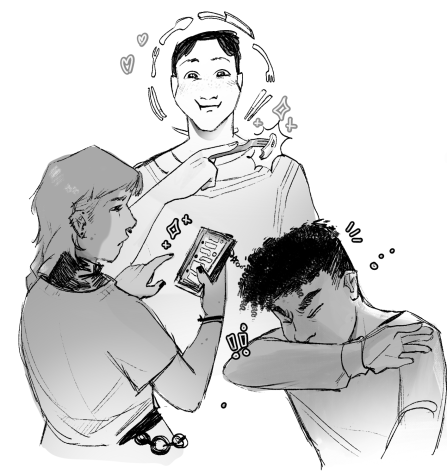
Illustration by M Hu.
Etiquette rules play a crucial role in social interactions, as they facilitate smooth communication and interactions among individuals. They provide a framework for respectful and considerate behavior, ensuring that everyone is treated with dignity and respect. Etiquette rules are especially important when considering class divisions, as they can help bridge the gap between different social classes and promote inclusivity. Etiquette rules, such as showing politeness, consideration and respect towards others regardless of their social class can foster a sense of mutual respect and understanding among individuals from different backgrounds. It is important to remember that etiquette is not about exclusivity or elitism, but it is rather about treating others with kindness, consideration and respect. Sharing our own ways of paying respect to one another is yet another way we can expand the language of behavioral etiquette.
At Whitman, many students I’ve met have expressed discomfort in communicating their needs and feelings to their professors because they do not know how to communicate with someone who is not in their social sphere or age range. Affording your professors the same respect they should be giving you (and knowing how to do that) opens hundreds of new doors for emotional and academic connection with those people who are here for the express purpose of teaching you.
Today, many people seem to believe that any consideration of subtle politeness is a hindrance to them and wonder only what actions they can get away with rather than what actions would be polite or impolite to do. There is an undermining of community and care afoot anywhere where there is such an extreme disillusionment with etiquette that it is no longer used at all. Even among friends, in the most casual of circumstances, there should always be a question of what is kind. In the end, it has nothing to do with formality on any essential level. It is only about a form of social contract of what gestures we can give to show appreciation and respect.
Not only does understanding how our actions are perceived allow us to have mobility outside of our own age bracket and social realms, it allows us to have the decency to build a community rather than trying to go it alone. No one can function without the kindness of others. To limit how much kindness you give based on an understanding that rules are a restriction only serves to liken freedom to a solitary life without support and love, which is no life at all.
Question of the day - What is your best tip for having good social etiquette?
Manners & Etiquette
What is your best tip for having good social etiquette?
Subscribe to our newsletter
Daily archives
Current Survey
Top 5 Contributors (Jul)

20209 pts

12060 pts

10714 pts

10417 pts

10117 pts